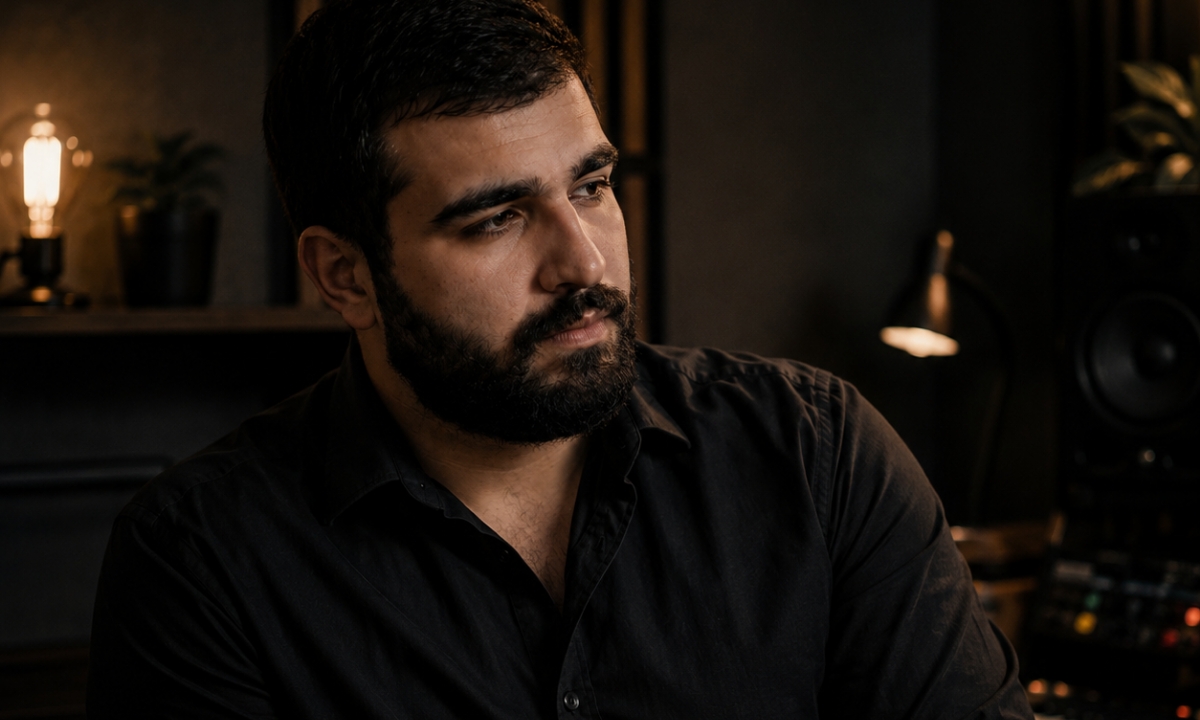
The main riff in ‘Limerence’ is about 15 years old. Serag Baddar wrote it at 15 or 16, knew right away that he had a melody that sounded professional, and then did something most young musicians never do. He put it away. Not because he lost interest, but because he could tell his songwriting and his playing weren’t yet good enough to turn the idea into the song he was imagining. He waited until they were.
That decision explains most of what there is to know about Serag Baddar, the 30-year-old composer based in Malta who released ‘Limerence‘ on August 13. He describes himself as a philosopher who happens to be a musician, and his rule for writing is short. Write for dopamine and nothing else. In his view, that’s what produces the highest quality material regardless of genre, whether the writer is working in jazz, country, or anything in between.
The practical effect of that rule is time. Lots of it. “The biggest difference between me and someone who writes traditionally is time,” Baddar says. “I take a really long time to get a song done because everything that I write has to make me feel like I’m listening to something from my favourite band. It’s difficult and time-consuming because you can only achieve this by working on sparks or what musicians call ‘the magic,’ which is when you get a burst of creative energy and write great things without wanting to.”
Sparks can’t be scheduled, which is why Baddar has built his creative life around not needing them to arrive on time. He treats music as a hobby rather than a career, he doesn’t play live shows, and he releases at his own pace. “There’s no pressure at all,” he says. “I do whatever I want and release material at my own pace, which is a great and necessary thing. If there was ever a demand, I wouldn’t be able to keep up with it because of the way that I write, on sparks.”
That’s a working life built on almost none of the usual incentives. No release schedule and no touring calendar, and by his own description, no interest in chasing algorithmic trends either. What he gets in exchange is the ability to sit on a good idea for a decade and a half without anyone asking where the next single is.
His route into music was ordinary enough. His father bought him a vintage Flying V and a small Kustom amp when he was around 14, though the guitar’s shape made it awkward to play sitting down and he didn’t take it too seriously. A year later his middle brother bought him a BC Rich Mockingbird, and that one stuck. He pushed past beginner level on his own, and by 16 he had a garage with two friends where he wrote most of his riffs. As he grew more introverted he got into production, taught himself to record guitar and vocals on software, and never looked back. Working in a DAW is how his songs start now.
What came out of that is post-rock, though Baddar has a blunter description for first-time listeners. Rock music without any of the distortion. His influences are heavy bands, but what he took from them was their quietest material. Opeth gave him only one fully clean record in ‘Damnation,’ and he wanted more of it. Tool, he says, tread the borderline of metal with incredible melodies on every instrument. Buckethead’s ‘Electric Tears’ and ‘A Real Diamond in the Rough’ he calls accessible post-rock gems. Wanting more of that music is what kept his distortion switched off.
‘Limerence’ was originally titled ‘Lotus,’ after Buckethead’s ‘Padmasana,’ whose rhythm guitar shaped one section of the track and whose title means lotus pose. The song runs 4:10, and the thing Baddar is proudest of is that the instruments aren’t following each other. Each part is doing something different. Rather than leave listeners to work that out, he ends the song by taking the hook apart. The main riff plays alone, then stops. The bass comes in. The second guitar riff joins the bass. Then everything plays together once, and the hook arrives with its construction laid bare. His claim is that all three parts sound good on their own and better stacked, which is what separates a demonstration like that from a gimmick.
The lyrics stay just as plain, built on repetition and one wry aside about a Metallica song he should have learned from. He wrote them late in the process, aiming to give something to a specific person while knowing the words would end up being about himself. He has called ‘Limerence’ his baby.
Next is an EP of his clean material, starting with vocals for ‘Electric Smoke,’ a bluesier track he wrote with Kyuss in mind. That work will take time, and he’s told fans it will be quiet until it’s done. “Work on it until it’s perfect,” he says. “That’s always worth it, even if it takes years.” A 15-year-old riff on a finished record is decent evidence he means it.
‘Limerence’ is available on Spotify and all streaming services, and the single can be purchased with the lyrics on Bandcamp. Baddar can be followed on Instagram and Facebook.