










Entertainment
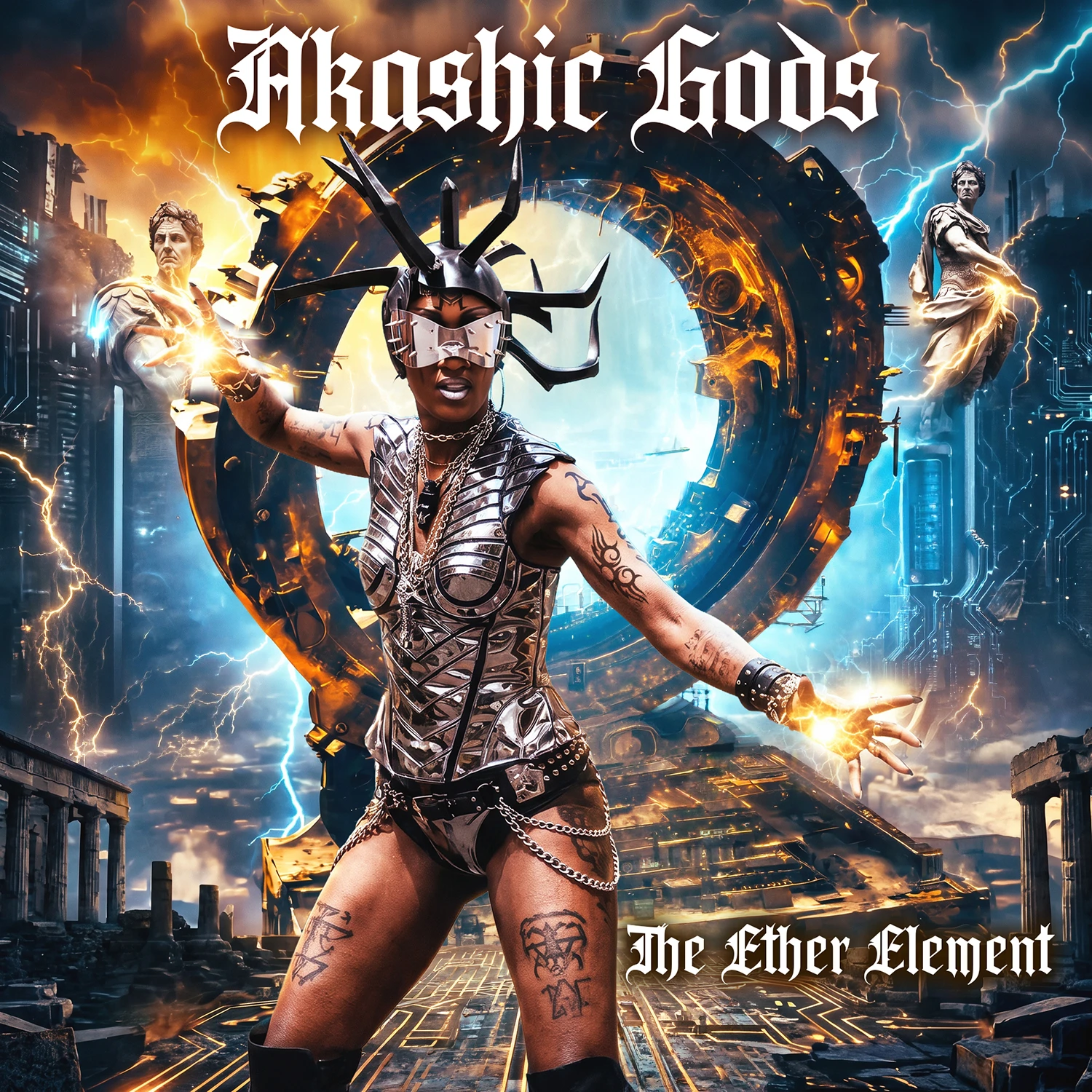
‘The Ether Element’ Finds AKASHIC GODS Forging Golden Armor From the Flames of the Past

Most records built on betrayal arrive swinging. The Ether Element, the debut concept album from AKASHIC GODS, spends much of it’s runtime serving as a sonic manifesto for the absolute opposite move, and the architect behind this one-woman reckoning positions walking away not as weakness but as ultimate triumph.
The album arrives this August alongside its focus single, “Bring in the Elohim,” and it’s built in two movements. The first, which she calls The System, deals with manipulation, technology and betrayal. The second, The Sanctuary, covers what happens after a person transcends all of it. Ten tracks move between garage-rock grit, orchestral strings and stacked choir-style vocal harmonies. Josh Robinson, CEO of LMSUK, the agency running the album’s marketing, played the album through in one sitting and described the album as “SO good,” adding, “I’m in shock.” He named “Surf the Future” as “definitely my favorite track of them all.” The two songs carrying most of the personal weight sit elsewhere on the record.
Arriving as the definitive focus single, ‘Bring in the Elohim’ anchors the album launch alongside a cinematic official music video. It’s built around an ultimatum, described in her words as an adversary’s “his way or the highway” position, and around what she chose to do instead of fighting back. “Conceptually, the song shuns petty physical retaliation, completely anchoring itself in the timeless scriptural promise that vengeance belongs solely to the Creator,” she says. “I paired that prophetic boundary with a bold, counter-cultural choice: weaponizing silence as my ultimate defence.” The lyrics lean on the language of spiritual warfare, with references to an “empire of lies” and a “smoke screen of wickedness,” but the tactic underneath is plainer than the imagery suggests. She names gaslighting as the dynamic she was writing against, and describes the song as the psychological victory of surviving a narcissistic abuser.
That decision has a history. AKASHIC GODS began in 2024, and the artist has been open that it came out of a period she describes as isolation trauma, deception and music exploitation, an environment she compares to Dante’s Inferno. The project name is deliberate. She designed the music to act as an archive, “a literal ‘Akashic record’ capturing the invisible battles of the human soul,” which is a useful way to understand what she’s doing with the material. Rather than settling scores publicly, she filed the experience.
“Karmic Justice,” track seven and the song that held No. 1 for four consecutive weeks on the UK Talk Radio Hot 100, deals with the collapse of a toxic relationship and the unmasking of a deceitful ex-partner. It sets the trappings of romance, “pink champagne, roses and alibis,” against a “Judas kiss.” She’s specific about what she was writing from, naming love-bombing as the mechanism and the hermetic maxim “as above, so below” as the frame she put around it. What keeps the song from curdling into a revenge track is where it ends. The line she points to as the climax is “in the dust of your nothingness is mercy of my forgiveness,” which lands less like absolution granted to someone else and more like a decision made for herself.
The production follows the same logic of contrast. Carlone Lewis and Alan Riggs anchored the verses of “Karmic Justice” with clean indie-pop guitar textures and a rigid drum loop, the polished version of the relationship, then ruptured the mix the moment the “Judas kiss” is exposed. “Bring in the Elohim” uses a similar structure, with claustrophobic lo-fi verses giving way to wide-panned distorted guitars, cinematic strings and layered ethereal harmonies. That single was mastered by Andy Baldwin at Metropolis Studios. Riggs, of Delta 5, is on board for future live performances alongside Lewis.
There’s a track record behind the album. Debut single “Gods and Machines,” which you can hear on YouTube, reached No. 2, was featured by Norwegian rocker Petter Wavold on his national TV music show, and has since passed 20,000 YouTube views and 13,000 Spotify streams. Second single “Weapons in Space” held No. 1 for three weeks on the UK Talk Radio Hot 100. The rollout is backed by social media music marketing agency LMSUK, with radio promotion for “Karmic Justice” handled by Medialuchs in Germany. Earlier this year she gave a red-carpet interview at the UK film premiere of Dream Hacker and turned up as a guest on the Martin Talk Show podcast. Before all of it, she travelled the world as a backing vocalist, toured with Secret Life, played Camden Club and Water Rats, and worked in dance music with DJ support from David Guetta and Fatboy Slim, an era she’s since left behind.
What she wants people to take from the album is stated plainly. “I want my listeners to look at their own scars not as permanent damage, but as the raw, heavy material used to forge unshakeable, golden armour,” she says. She frames the record as a blueprint for self-preservation, aimed at anyone dealing with a toxic relationship, a hostile environment or a rigged professional situation.
Which brings the thing full circle. The song she describes as a stadium-sized wall of sound is the one about refusing to say anything at all, and that contradiction is the point. Silence only reads as defeat if someone else is keeping score.
Follow AKASHIC GODS on Instagram, Spotify, Facebook, TikTok and X.
Listen to the Ether Element album on Spotify.
For further background on AKASHIC GODS’ artistic evolution, career history and the release of “Weapons in Space,” see this Just News International feature.
Album artwork by DesignerAde Ltd.